
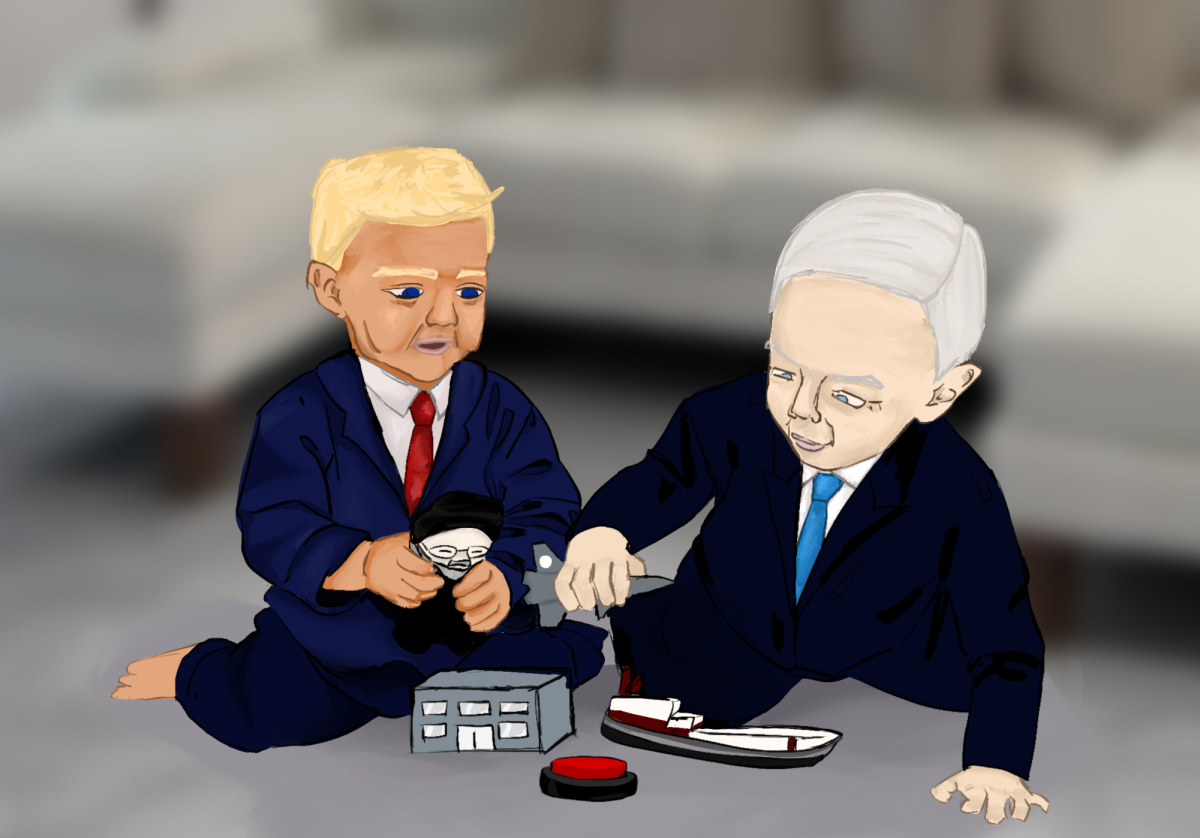
On Feb. 28, the United States and Israel began to conduct airstrikes and bombings on the sovereign nation of Iran in a brazen and brutal act of war. On the first day alone, Israel assassinated the Supreme Leader and his family as well as a number of high ranking Iranian figures. Additionally, the United States struck an elementary school and killed an estimated 175 people, an act that the administration denies conducting. The United Nations Human Rights Chief Volker Turk said that the United Nations was worried about the strikes’ compliance with international law.
This conflict also carries immense consequences for the globe. One of the most immediate economic problems revolves around the blockade of the Strait of Hormuz, a narrow waterway approximately 30 miles wide, through which roughly 20% of the world’s oil supply passes through each day. Since the beginning of the war oil and gas companies have shut down operations, and marine traffic through the gulf has slowed dramatically with only IRGC-approved ships allowed through. Any prolonged closure of the strait will have a devastating impact on the global economy.
In 2025, the United States conducted strikes on Iran’s civilian nuclear facilities and claimed they had set nuclear weapon development back two years. Yet in justification for this war, the administration claimed that Iran posed an imminent nuclear threat. As journalist Jeremy Scahill pointed out, these claims are at odds with each other: “You either totally obliterated the [nuclear weapons] program or it’s gotten so advanced that they’re a week away from [completing] it.” This inconsistency is compounded by the lack of verifiable evidence that Iran has been developing nuclear weapons.
This kind of mixed messaging is indicative of the Administration’s inability to maintain a coherent narrative of why they do what they do. In a video released on Donald Trump’s personal website, he claimed that he wanted to induce regime change, save the Iranian people, and target Iran’s supposed nuclear weapons facilities. These shifting justifications of war undermine the public’s trust.
The timing of this war also raises further questions about the political incentives at play. In recent months, public attention has been fixed on the release of documents tying Donald Trump and his advisors to notorious pedophile, Jeffrey Epstein. A recent survey conducted by Data for Progress found that 52% of American Voters believe the war with Iran was launched at least in part to distract from the Epstein files, with only 40% rejecting that explanation. With Republican voters, over a quarter expressed the same suspicion. Whether intentional or coincidental, this escalation with Iran has shifted the national conversation away from the numerous career-ending allegations against Trump.
The situation inside Iran was already volatile long before the bombs began falling. For months, protests against the Islamic Republic and its repressive leadership structure had erupted across the country. These protests were largely fueled by the economic impact of U.S. sanctions that have collapsed the value of the Iranian rial; One U.S. dollar is the equivalent of 1,317,000 Iranian rials. These demonstrations were met with indiscriminate firing on crowds by the Islamic Revolutionary Guard Corps (IRGC) and its paramilitary forces, the Basiji.
Since the Revolution of 1979, protesters have demanded greater political freedom, an end to corruption and civil liberties protections. Senior Lex Ramani explained how the months of anti-regime protests and the brutal crackdown that followed impacted his family: “We’ve had about five deaths in the past month… two of them were at a protest where they basically mowed down almost 40 people, and others were tortured and interrogated. One of our friends spoke out online, was kidnapped and tortured, and we later received a package with her belongings.”
At the same time, information inside Iran has become increasingly harder to find. The Iranian government has a policy of restricting internet access during periods of unrest and conflict, which they continue to enforce. Senior Maneli Malboubi described the anxiety that she and her family feels during this time of inconsistent communication: “Not being able to contact your family is very scary. You’re always wondering if they’re okay.”
It’s important to acknowledge that the current Iranian state is not synonymous with the Iranian people and supporting the civil rights and safety of Iranians does not mean supporting those that rule over them.
This distinction should also be applied to the nations directing this war. How can a country claim to be fighting for the liberation of the Iranian people while simultaneously conducting a genocide on the people of Palestine? Malboubi put it plainly: “Yes Israel is helping Iran get rid of the Ayatollah and the Islamic Republic. But they’re still, in my opinion, doing genocide in Gaza.”
Israel has wanted to wage this war against Iran since the aftermath of the Iranian Revolution and when Iranian proxies fought back an Israeli invasion of Lebanon in the 1980s. The genocide in Gaza has further isolated Israel from the international community as they continue to wage war on the people of Lebanon, Syria, Palestine and beyond.
History has shown that acts of imperialism and wars of aggression rarely solve the problems that triggered the initial conflict. This war has already begun to tear apart families and destroy communities throughout the region. According to a United Nations report released Thursday, over three million people have been forcibly displaced across the region. As Ramani said, “the more focus we put on the people that are being hurt because of this, the more clear the answers become. No one wants war. No one wants violence.”
This is not a war of liberation. The United States has a long history of intervening overseas and leaving nations shattered. The bombs falling on Tehran will not create democracy just as the bombs that fell on Iraq, Libya and Afghanistan did not. If the goal is to support the Iranian people then this is the wrong direction to take. Democracy cannot be imposed through airstrikes and destabilization will not end the mass suffering.