
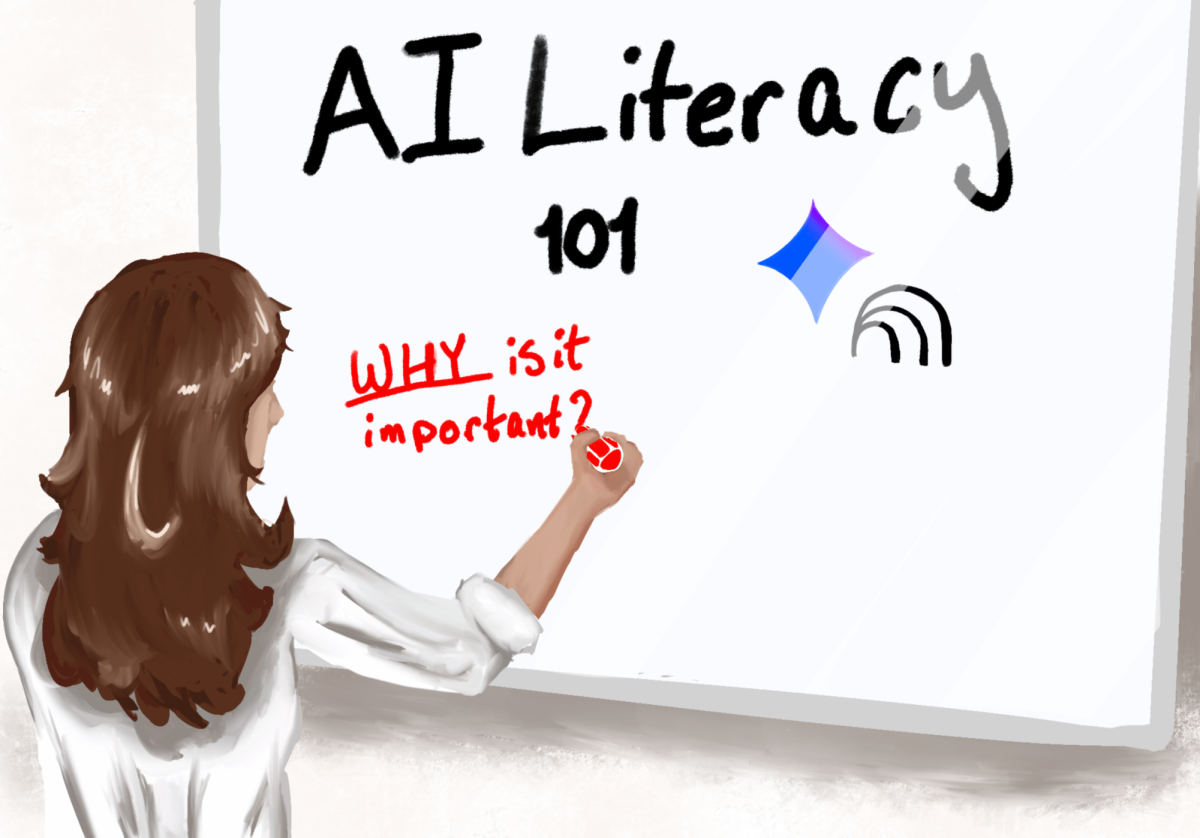
Artificial Intelligence exists in sectors all around us from entertainment to politics. It has been met by the public with enthusiasm, push back, and apprehension: some feel like we’re losing our agency as our world turns more dystopian and others see a wonderful innovation that will transform our efficiency and efficacy. There is also rising concern about the “AI Bubble” – which has been compared to the “dot-com” bubble in the 1990s – sustaining our economy and therefore rising fear of that bubble popping.
Regardless of where one falls on this spectrum of thought, it’s difficult to deny AI’s impact and place in our future. For students who will eventually enter the workforce, AI will likely be a language they need to learn in order to best communicate. The AUHSD has emphasized the importance of AI literacy for students which means learning how to appropriately, and most effectively, use these tools. The district is considering providing students access to the Gemini large language model and NotebookLM through their Google Workspace for Education accounts.
Both Gemini and NotebookLM have educational features and regulations designed for academic settings. NotebookLM is a good resource for summarizing journal articles, textbooks, and class notes. It also offers a custom Q&A for materials users input. Gemini is considered to be more creative than NotebookLM but has more hallucinations. It can mold its answers to specific learning styles, helping users to absorb information in a way that is best suited to them. These AI platforms also offer exam preparation resources including synthesizing study notes (NotebookLM) and making practice questions (Gemini).
Learning Skills teacher Natalie Goepel sees the benefits of teaching students how to use AI. She said, “I do think AI is incredibly useful to teach students how to use it well. It will be a huge part of the future, so I think, as a learning skills teacher, that is some piece of my job.”
Generally, Goepel thinks teachers who are interested in using AI have already started incorporating it in their teaching. In her own classroom Goepel has used AI to create personalized career awareness assessments. She said “part of the class is helping students explore themselves and their identities…what it feels like and what might be a good fit for them in the future.” When curating lists of potential careers Goepel thinks “AI can give a more holistic list of recommendations.”
As students are navigating these tools it is important to think of them as academic assistants rather than replacements for real work. This framing can help preserve opportunities for critical thinking.
So far, students have been navigating AI tools without formal curriculum guidance provided by schools. Some students have been able to strike a healthy balance, with AI usage, on their own. Senior Aila Lind has used AI to help her understand a confusing physics or math problem. She tries to keep her overall usage minimal because she’s noticed that it impacts her abilities to take notes in her own words – something that helps one learn and retain information. However, Lind acknowledges AI is a big part of the world and its impact is only growing. While she isn’t “a big fan of it” she said “we’re going to need to be educated on it.”
Sophomore Quinn Baker agrees that “it’s really important for students to be able to use AI because a lot of the jobs in the future are going to be replaced.” Currently Baker personally utilizes AI to “help explain concepts” which she finds “more helpful than reading articles because you can ask specific questions [that are] tailored to exactly what you need to know.”
Baker thinks students need to have thoughtful reflections about their AI usage to ensure that it remains beneficial as a tool. “You need to be honest with yourself about whether you’re using it to replace your own thinking or if you’re using it to help you understand things,” said Baker.