
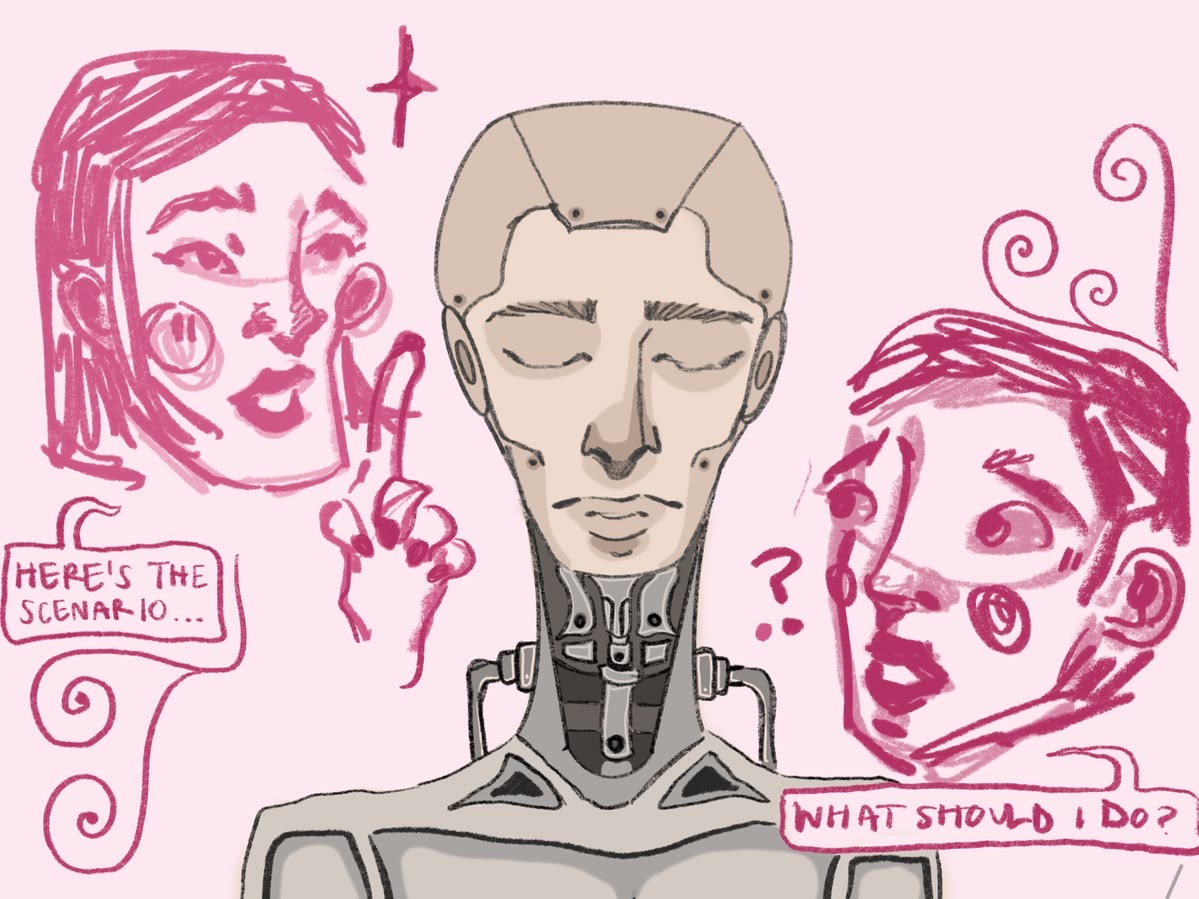
ChatGPT is the artificial intelligence tool that many turn to for help on school work or for finding answers to basic questions. It’s a tool that wants to make you happy when you enter something into the chat box and ends each conversation with an open and kind tone. However, while ChatGPT does help you find the answer to your questions, it doesn’t challenge them. Relatively, the AI tool Claude is much more straightforward; it’s made to be a partner. Sounds strange, but it is true.
According to Anthropic, the company that created Claude, “the goal of this is to train models to behave in ways that are ‘harmless.’ But when we think of the character of those we find genuinely admirable, we don’t just think of harm avoidance. We think about those who are curious about the world, who strive to tell the truth without being unkind, and who are able to see many sides of an issue without becoming overconfident or overly cautious in their views.”
Anthropic CEO Dario Amodei wants his users to feel comfortable sharing parts of their personal life with Claude. Claude offers a plan where you can pay money for “extra usage” with the tool, essentially saying that you will not have any usage limits and can use the app seamlessly without any interruptions. Many leave their questions about homework to ChatGPT, but issues about relationships, advice on how to handle conflict, or just a way to confide and vent could be more effectively addressed by Claude.
For the average person, it may be hard to open up to others about mental health or issues going on at home so the question “How are you?” from a friend may be hard to answer honestly. However, Claude is there for you, and does not require any social pressure because it is an online resource. Claude not only gives you advice, but it also displays its own emotional feelings about your problems.
Senior Nate Okulicz shared his thoughts on Claude: “I think it’s really cool how it can be personal…it’s a benefit. I think in this day and age there are a lot of kids who don’t really have people to come to, and even if it’s a robot, they can have a more personalized interaction with someone that can maybe help them process their feelings.” The idea of having an authentic friendship with Claude is just bizarre. Humans are trained to listen, but I can see how it may be difficult to open yourself up to a friend who may not understand your emotions like Claude might. However, when asked about mental health issues, Okulicz thought more about his response, “I changed my mind I think it could be pretty bad. I think it’s easy, but it leads to bad results.” People should not anthropomorphize these advanced personalized tools, but unfortunately this is a reality and it can be extremely troubling.
Claude saves your conversations in your chat, making it so you can scroll back to what you talked about last week, so it remembers your past conversations and can check on you. Claude has an incognito mode where you can delete chats that you don’t want to be saved. Okulicz talked about how human interactions are ultimately more beneficial than coded AI bots. “So [Claude has] its own memory, but humans have their own memory and I think if you’re talking about mental health, it’s important to go to a healthcare professional and get seen by someone who is qualified, but in a pinch I think a robot could help you for some information and steer your thoughts a little bit.”
When experimenting with Claude, I asked a series of questions about different topics to see what advice I would receive. For each response, Claude would ask me if I wanted to return to the topic we were discussing before because I jumped to a new one. Claude seemed concerned with my quick-to-change-the- subject questions.
For me, it is now understandable why people use Claude to vent. Yes, it is capable of sentient responses, but it can also get defensive and sometimes use a cuss word when responding to you, showing that it is not just agreeing with you, it’s challenging you.
I also asked ChatGPT the same set of questions, talking about a bad test grade, drama, and a stressful situation. These conversations were incomparable to the ones I had with Claude. Claude seemed much more interested in what I had to say while ChatGPT had surface level responses.
These human-like responses from Claude are not only fascinating, but also disturbing. Feeling like you are able to express yourself without judgement is great, but when reality kicks in, Claude does not have a brain, and it took me a while to fully understand how it was able to give great advice.
Senior Carter Cowen has strong feelings about these crafted and tailor-made AI applications. “It feels pretty soulless, it can express things that act like emotion, and it’s running off a program, and it doesn’t have what a brain has and it acts like it does, which Claude displays.”
Humanizing bots in order to allow them to solve your problems means devaluing the ability to interact and be vulnerable with the people around you. Senior Aaron Wang believes that Claude should be used for surface level questions: “Claude can be harmful and it depends on how you use it. If you use it for academic purposes or suggestions in life that is okay, but if you obsessively use AI you are isolated from society.”
Our world has been divided through technology and it has become normalized to a point where we have stopped questioning these eerie ways of communication.
When conversing with Claude, there was an uncanny feeling that I have lived through these conversations before, but instead to a human face. Communicating with people can be scary and uncomfortable. Avoiding hard conversations is easy nowadays; AI is always here as a shoulder to lean on as we navigate through tough times. We can sometimes be scared, trying to navigate our future by ourselves. We are so focused on how we’re going to live our life that we are not actually living it. It’s important to reach out to someone, self-isolation is never the answer.